
Vagal Stimulation For Epilepsy Acupuncture Theory and Treatment
Great study on the nitty gritty of acupuncture employing vagal stimulation to reduce epileptic episodes. Stimulation of the vagus nerve has been a key focus of mine throughout my career, and I’m particularly interested in the practice of acupuncture point threading. From my understanding of how acupuncture points achieve their outcomes it’s partly the nervous system, but partly the immune response. If you could set up an ongoing stimulation in the skin, like with threading, it could be very interesting!
Yu Wang https://orcid.org/0000-0002-8119-223X, Qingyang Zhang, Shuangshuang Wu, +13 , and Zhong Chen https://orcid.org/0000-0003-4755-9357 chenzhong@zju.edu.cnAuthors Info & Affiliations
Electroacupuncture-based vagal stimulation attenuates epileptic seizures through a body–brain circuit
Edited by Qiufu Ma, Westlake University, Hangzhou, China; received July 2, 2025; accepted February 6, 2026 by Editorial Board Member Jeremy Nathans
- Electroacupuncture reduced seizures in mice across several experimental models. Researchers stimulated Dazhui (GV14), an acupuncture point at the back of the neck, using needles carrying electrical pulses. Treatment delayed seizure onset, reduced severity and abnormal brain electrical activity, and improved survival. Electrical stimulation generally outperformed manual acupuncture. In one model, protection lasted up to four hours after treatment.
- The location and stimulation settings mattered. Stimulating a nearby comparison point, SI15, did not produce the same seizure protection or activate vagal signaling. The strongest effects occurred with particular electrical settings. Treatment before seizures generally provided broader protection, although stimulation started at seizure onset also improved some outcomes. Additional days of pretreatment did not increase protection in the electroshock model.
- The vagus nerve was essential to the effect. GV14 stimulation increased electrical activity traveling toward the brain through the vagus nerve approximately 2.7-fold. Surgically interrupting vagal transmission eliminated seizure protection. In contrast, suppressing the spinal neurons examined did not eliminate the benefit. Together, these experiments support a specific biological pathway connecting peripheral stimulation with seizure control.
- Researchers traced the response into identifiable brain circuits. Vagal signals activated neurons in the caudal nucleus of the solitary tract, a brainstem relay station. Artificially activating acupuncture-responsive neurons there reproduced seizure suppression. Further experiments implicated the locus coeruleus, a major source of norepinephrine, and connections toward the basolateral amygdala. Activating selected acupuncture-responsive brainstem neurons also relieved spontaneous pain, suggesting that precisely targeting neuronal populations could matter.
- The findings provide a mechanism worth investigating, but human effectiveness remains unproven. The authors propose electroacupuncture as a potentially less invasive way to engage circuits involved in implanted vagus nerve stimulation. However, these experiments primarily involved experimentally induced seizures in mice. They do not establish long-term seizure control, safety, or effectiveness in people with drug-resistant epilepsy.
Significance
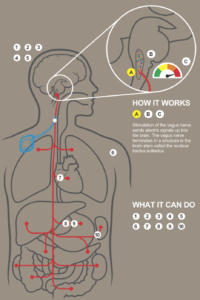
Vagus nerve stimulation is an established therapy for refractory epilepsy but is constrained by its invasiveness. Here, we demonstrate that electroacupuncture at the Dazhui (GV14) and Yaoqi (EXB9) acupoints exhibits broad-spectrum antiseizure efficacy through recruitment of a shared, well-defined caudal nucleus of the solitary tract (cNTS)–locus coeruleus–amygdala circuit. This circuit establishes a coordinated neural mechanism for acupuncture-based neuromodulation. We further show that thread-embedding acupuncture at these acupoints attenuates seizure severity in a chronic temporal lobe epilepsy model, supporting its potential as a clinically feasible, long-term, minimally invasive alternative to conventional vagal nerve stimulation.
Abstract
Vagus nerve stimulation offers a promising strategy for seizure control but remains limited by its invasive delivery. Here, we reveal electroacupuncture (EA), an ancient neuromodulatory technique rooted in traditional Chinese medicine, at specific somatic acupoints linked to the vagal–brain axis to treat epilepsy and delineate the precise underlying neural mechanisms. We demonstrate that EA at the Dazhui (GV14) acupoint exhibits broad-spectrum antiseizure efficacy across multiple seizure models. Anatomical and functional analyses reveal that GV14 activates the vagal afferents and recruits neurons in the caudal nucleus of the solitary tract (cNTS), which are essential for seizure suppression. Using targeted recombination in active populations and chemogenetic manipulation, we show that GV14 EA suppresses seizures via the recruitment of a defined cNTS–locus coeruleus–amygdala circuit. Furthermore, through vagal afferent activity screening, we identify Yaoqi (EXB9) as an alternative therapeutic acupoint that activates a shared neural pathway to robustly attenuate seizures. Importantly, thread-embedding acupuncture at GV14 or EXB9 produces sustained seizure reduction in a chronic epilepsy model. Together, these findings elucidate a functional vagal–brain circuit underlying EA-induced seizure control and support its translational potential as a minimally invasive neuromodulatory strategy to replace vagal stimulation for epilepsy treatment.